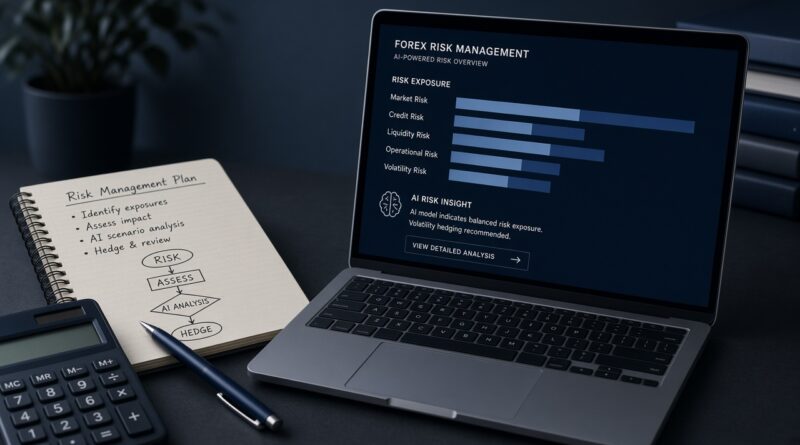
Forex Risk Management With AI: Position Sizing, Journaling and Analysis
The phrase forex risk management AI should describe a helper that does arithmetic and review. It should not describe a bot that “manages risk” by hiding losses in a grid. This article stays on the first meaning: size, journals, and analysis you can explain to another adult.
If you later test a rule in code, use AI forex backtesting. If someone promises that AI removed drawdowns, read the scam warning list instead of depositing.
Start with cash, not with pips
Decide three numbers before any model speaks:
- Money you can lose this month without changing rent, fees, or family support.
- A daily stop in that same currency.
- A per-trade stop that is a slice of the daily stop—not the other way around.
Ask an assistant only to check the arithmetic: “Stop is 40 points, value per point is A, risk is B. What size follows?” If the size is tiny, that is the answer. AI does not get to enlarge B because the chart “looks clean.”
This cash-first habit is the same idea as a household reset: pick a hard number, then live inside it. We have written about that mindset on the personal-finance side in rebooting your finances and using AI for budgeting. Trading risk is not a budget surplus. It is a loss you pre-accept.
Position sizing prompts that stay safe
Good prompts are narrow:
- “Given this stop distance and this cash risk, compute units. Show the formula.”
- “I already have two USD-long positions. If I add this third pair, describe the shared driver. Do not tell me to take the trade.”
- “If I am wrong, what is the account percentage loss? Use my numbers only.”
Bad prompts invite the model to become a coach: “How can I recover this week?” Recovery language is how people double size. A tool that answers that question with a new trade is not risk management.
Journaling with AI without rewriting history
Paste session notes and ask for a table: planned risk, actual risk, rule break, emotion. Ban the model from smoothing the story. If you planned 1.0% and took 2.4%, the journal must show 2.4%. Over a month, cluster the oversize events. That cluster is your real system.
Keep the official broker export as the source of truth. Language models drop rows and merge fills. Your tax file and your memory should not depend on a chat thread.
Analysis that reduces repeats
Once a week, ask for analysis that is closer to operations than to prediction:
- Which session created the most unplanned trades?
- Which pair consumed the most spread relative to the move?
- Vkm
- Did news sit inside the stop on losers?
- Did you trade after hitting the daily stop anyway?
Those questions improve forex risk management AI use because they attack process. Directional questions (“will gold trend?”) belong in a different article—and even there we recommend description over prophecy in XAU/USD analysis.
What “AI risk tools” should never do
- Martingale, grid recovery, or “hedge until it works.”
- Hide open losses in a second account view.
- Raise leverage automatically after a win streak.
- Require a special broker you cannot verify in a public register.
Those features transfer risk from the vendor’s marketing page onto your balance. Public CFTC forex material is explicit that leverage and dealer conflicts can wipe a retail deposit. A dashboard that looks calm is not a hedge.
A one-page policy you can reuse
Write this in your own words and pin it:
- I size from cash risk and stop distance. I do not size from conviction.
- I stop for the day when the daily cash limit is hit, including commissions.
- I do not add to a loser except when a written plan already allowed a scaled entry—and I still count total risk.
- I review journals weekly. I do not add a new strategy in the same week I broke a rule.
- I do not give any bot withdrawal permission.
You can ask an assistant to turn this into a checklist you tick before the session. You should not ask it for an exception because “today is different.”
Bottom line
Use forex risk management AI to compute size, keep journals complete, and find repeated leaks. Do not use it to predict, recover, or justify a larger bet. The market does not care that a model agreed with you.
Educational note: This article is for general information only. Forex and related leveraged products are high-risk. You can lose money quickly, and in some account types you can lose more than you deposit. Nothing here is investment, trading, or tax advice, and no tool, bot, or model can guarantee profit. If you trade, use money you can afford to lose, understand your broker’s costs, and check the rules in your country (for example the CFTC forex advisory in the United States, or your local regulator).