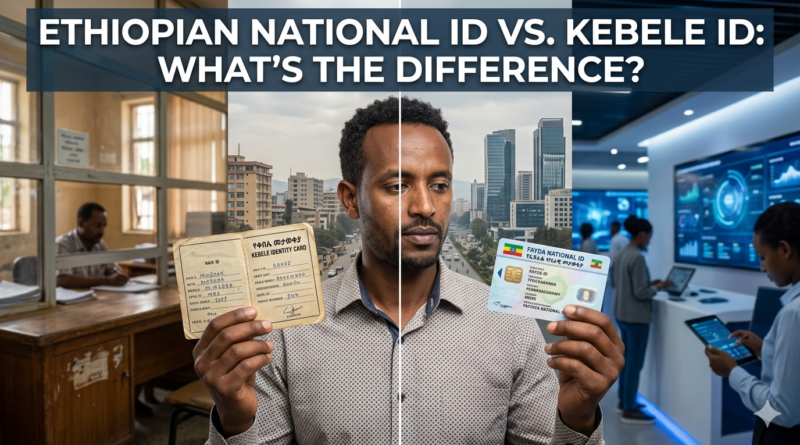
Ethiopian National ID vs Kebele ID: The Real Difference Every Ethiopian Should Know
In recent years, Ethiopia has been rapidly modernizing its identification system. From banking and SIM card registration to online government services and digital payments, proving your identity has become more important than ever. Yet many Ethiopians still ask the same question: What exactly is the difference between the Ethiopian National ID and the Kebele ID?
At first glance, both documents seem to serve the same purpose. They verify who you are, where you live, and allow access to services. But in reality, these two IDs are very different in terms of legal power, technology, security, and future use. Understanding the distinction is essential for anyone opening a bank account, applying for jobs, accessing government programs, or preparing for Ethiopia’s digital future.
What Is the Ethiopian National ID?
The Ethiopian National ID, commonly called the Fayda ID, is Ethiopia’s new digital identification system designed to create a single, secure, and nationally recognized identity for every citizen and resident.
Unlike traditional paper-based systems, the National ID uses modern biometric technology such as fingerprints and facial recognition. Each individual receives a unique identification number that can be verified digitally across different institutions.
The goal is simple: create one trusted identity system for the entire country.
The National ID is being introduced to improve:
- Digital government services
- Financial inclusion
- Online verification
- Banking security
- Fraud prevention
- Access to social services
The system is managed at the federal level and aims to replace fragmented identification methods used across different regions and institutions.
Today, many banks, telecom companies, and government offices are beginning to integrate the National ID into their systems.
What Is a Kebele ID?
A Kebele ID is the traditional local identification card issued by a person’s local kebele administration.
For decades, this has been the most commonly used identification document in Ethiopia. It contains basic personal information such as:
- Full name
- Address
- Age or date of birth
- Photograph
- Kebele registration details
The Kebele ID mainly proves that a person lives within a specific local administrative area.
Because it is issued locally, the design and quality may vary from one region or city to another. Some are laminated paper cards, while others are more modern plastic IDs.
fyd
Although the Kebele ID is still widely accepted for many everyday activities, it has several limitations compared to the National ID system.
Why Ethiopia Is Moving Toward National Digital Identification
Ethiopia’s economy and digital infrastructure are growing quickly. More services are moving online, and traditional paper-based identification systems struggle to meet modern security and efficiency demands.
The National ID system helps solve several major problems:
Fraud and Duplicate Identities
Traditional IDs can sometimes be forged or duplicated. Biometric verification makes this far more difficult.
Financial Access
Millions of Ethiopians remain outside the formal banking system. A secure digital identity helps banks verify customers faster and more safely.
Efficient Government Services
A centralized identity system allows easier access to healthcare, social protection programs, education, and public services.
Digital Transformation
As Ethiopia expands e-government services and digital payments, a reliable identity system becomes critical for national development.
This shift also aligns Ethiopia with global digital identity trends seen in countries like India, Nigeria, and Estonia.
Key Differences Between National ID and Kebele ID
Understanding the practical differences between these two IDs is important.
| Feature | Ethiopian National ID | Kebele ID |
|---|---|---|
| Issued By | Federal system | Local kebele administration |
| Technology | Digital and biometric | Mostly paper or basic plastic |
| Coverage | Nationwide | Local area only |
| Security | High security verification | Lower security |
| Database | Centralized national database | Local records |
| Recognition | Growing national acceptance | Traditional local acceptance |
| Fraud Protection | Strong biometric protection | Easier to forge |
| Online Verification | Yes | Usually no |
| Future Government Integration | High | Limited |
The National ID is designed for the future digital economy, while the Kebele ID mainly serves traditional local administrative purposes.
Can You Still Use a Kebele ID in Ethiopia?
Yes. The Kebele ID is still accepted in many places across Ethiopia.
You can often use it for:
- Local administrative services
- Small banking transactions
- Address verification
- Some job applications
- Community-level services
However, its acceptance is gradually becoming more limited for high-security or digital services.
Many institutions now prefer or require stronger identity verification systems due to fraud prevention and regulatory compliance.
Over time, the National ID is expected to become the primary identification system nationwide.
Is the National ID Mandatory in Ethiopia?
Currently, Ethiopia is in a transition period.
Not everyone has a National ID yet, and registration continues in phases across different cities and regions. However, the government strongly encourages citizens to enroll because the ID will play a major role in future services.
Several sectors are already integrating it, including:
- Banking
- Telecommunications
- Government portals
- Financial technology services
- Tax systems
- Social protection programs
As digital transformation accelerates, the National ID will likely become increasingly essential.
Benefits of the Ethiopian National ID
The National ID offers several advantages over the traditional Kebele ID.
Better Security
Biometric verification significantly reduces identity theft and document forgery.
Faster Access to Services
Many digital services can instantly verify identity without requiring multiple documents.
Nationwide Recognition
Unlike Kebele IDs, which are tied to local administrations, the National ID works across the country.
Improved Banking Access
Banks and financial institutions benefit from secure customer verification, helping reduce fraud and improve compliance.
Support for Ethiopia’s Digital Economy
Digital identity systems are foundational for e-commerce, fintech, online education, and digital government services.
Challenges Facing the National ID System
Despite its advantages, the rollout of Ethiopia’s National ID system also faces challenges.
Limited Awareness
Many people still do not fully understand the difference between the National ID and Kebele ID.
Internet and Infrastructure Gaps
Digital systems require stable infrastructure, which may not yet be equally available in all regions.
Enrollment Delays
Because Ethiopia has a large population, nationwide registration takes time.
Privacy Concerns
As with any biometric system, some citizens worry about data protection and privacy management.
Still, experts believe digital identification will become increasingly important as Ethiopia modernizes its economy.
Which ID Is Better for Banking and Financial Services?
For banking, fintech, and digital financial services, the National ID is clearly more powerful.
Banks prefer secure digital verification because it helps them:
- Reduce fraud
- Meet compliance regulations
- Verify customers quickly
- Improve online banking security
This is especially important as Ethiopia’s fintech sector continues expanding.
High-value financial services increasingly require stronger identification standards, making the National ID more future-proof.
Will the National ID Replace the Kebele ID Completely?
Most experts believe the National ID will eventually become Ethiopia’s primary official identification system.
However, the transition may take years.
The Kebele ID still plays an important role at the local level, especially in areas where digital infrastructure is still developing.
Rather than disappearing overnight, the Kebele ID will likely become less central as more institutions adopt the National ID system.
How to Register for Ethiopia’s National ID
Registration processes may vary depending on location and rollout phase, but generally involve:
- Providing personal information
- Presenting supporting documents
- Capturing biometric data
- Receiving a unique identification number
Citizens are encouraged to follow updates from official government channels regarding registration centers and eligibility.
belongs to secure digital identity systems.
As Ethiopia continues investing in technology, financial inclusion, and e-government services, the National ID will likely become essential for everyday life. From opening a bank account to accessing healthcare, applying for jobs, receiving government support, or even verifying mobile services, digital identification is becoming deeply connected to modern society.
For ordinary citizens, understanding the difference between the National ID and the Kebele ID is no longer optional. It is becoming a practical necessity.
Final Thoughts
The Ethiopian National ID and the Kebele ID may both serve as forms of identification, but they represent two completely different systems.
The Kebele ID reflects Ethiopia’s traditional local administrative structure. It has served communities for decades and still remains important for many local services. However, its limitations in security, nationwide verification, and digital integration make it less suitable for the modern digital economy.
The National ID, on the other hand, is built for the future. With biometric security, centralized verification, and nationwide recognition, it is designed to support Ethiopia’s growing digital infrastructure and financial ecosystem.
For Ethiopians, the smartest approach is to understand both systems while preparing for the country’s digital transition. As more services adopt modern verification standards, having a National ID will become increasingly valuable.
Whether you are a student, business owner, employee, freelancer, or entrepreneur, staying informed about Ethiopia’s evolving identification system can help you access opportunities faster, safer, and more efficiently.
As Ethiopia moves toward a more connected digital future, one thing is becoming clear: the National ID is not just another document — it is the foundation of the country’s next generation of services and identity verification.